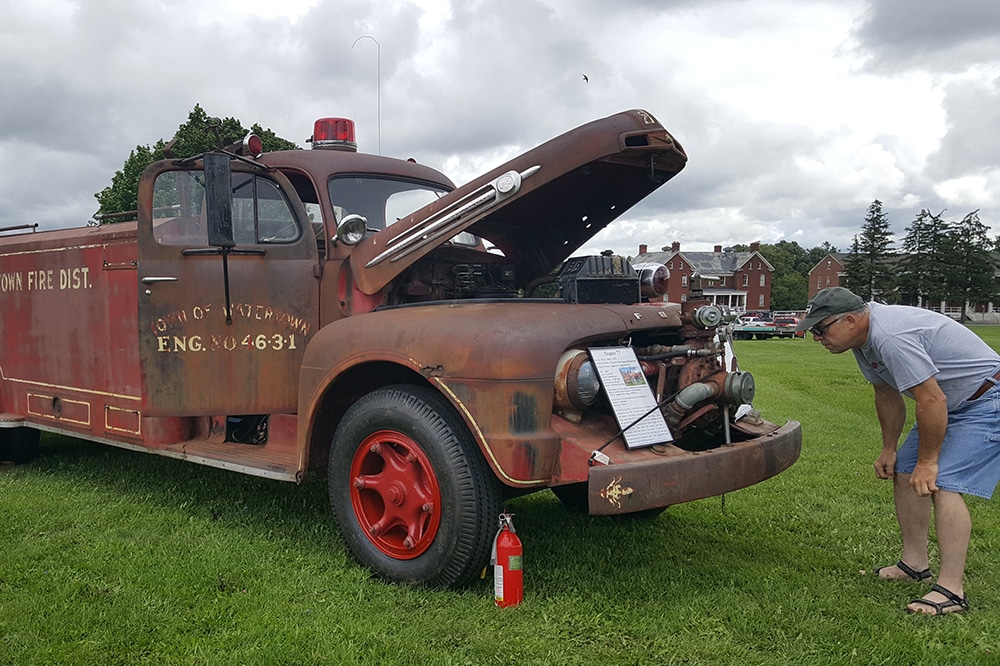
SOUND THE ALARM! After years of waiting, the bell has rung! On May 15, the City Council of Watervliet, New York, approved my sealed bid, and I became owner of a 1926 American LaFrance 750 gallon-per-minute pumping engine.
That’s the opening of a letter written to relatives and Syracuse-area friends, to none of whom was my long-time desire to own a vintage fire engine a secret.
An unofficial corporation has been formed, under the name of SPAAMFAA-the Society for the Preservation and Appreciation of Antique Motor Fire Apparatus in America.
The name had actually been invented a year before, for a tongue-in-cheek article drafted for (but wisely not printed by) a weekly newspaper in Sherburne, New York, explaining why several members of the Syracuse University rowing team and I had spent a 1957 Spring afternoon peering at ancient apparatus through fire station doors in Syracuse and a dozen other Central New York communities.
Months earlier, my first bid on an engine (an ex-Syracuse 1923 Ahrens-Fox) had come up short, leaving window-shopping, and research into rigs which might soon be retired, to keep the spark alive.
One general query took the form of a “wanted” listing in the 1957-58 edition of The Visiting Fireman, and the sole response was from Watervliet’s City Manager, advising that their retired ALF was for sale. That led to an immediate inspection trip (suffering from four years of neglect, she was stripped and rough, but running-and I loved her!), and my bid of $182.50.
Acceptance of the bid, and analysis of the additional cost of work required for a 150-mile trip home matched against a graduate student’s bank balance brought that unpublished article to mind, and the search for help was on.
Shares are available at only five dollars each. To take advantage of this once-in-a lifetime offer, indicate the number of shares you’d like to hold, and return with cash, check or money order (made payable to Richard A. Horstmann) – and you’ll be in! It’s an exclusive group, and one you’ll be glad to join.
How glad folks were about it isn’t recorded, but join they did. Friend and co-worker Mary O’Brien was first aboard (stock certificate number 2), followed shortly by lifetime best friend Dr. Hamilton Dixon, and – bless them – my parents, Margaret and Henry Horstmann, my brother and sister-in-law, and my aunts and uncles. Right behind were still more friends from college and work, along with a few members of the buffing fraternity. (While legends aren’t meant to be tampered with, fact required dispelling the notion that all of SPAAMFAA’s first members were enthusiasts of the fire service. The sanity of 1958’s originals can, however, still be questioned on whatever other grounds may have motivated their participation in dollars and in spirit.)
So here we were in late May of ’58 – some 20 people and $400 strong – with a fire engine, christened SPAAMFAA Engine 1. After tuning and extensive patchwork, ALF Type 75 No. 5751 started home to Syracuse – and made it! A garage was rented from the typical little old lady who made any little old lady’s typical request: Because it’s noisy, please don’t disturb me or the neighbors by taking the engine out at night or on Sunday. My promise was solemnly made and kept for four whole days.
Sirens downtown signaled a major midnight blaze as Ham Dixon and I worked on his car in the little old lady’s garage – and, well, we just had to take the Alfie, embargoed or not, wanted at the fire or not. Of course the rig made a racket, of course we woke up the neighborhood, but it was wild, and fun, and we were right in the middle of a three-alarmer all night – as well as in deep trouble when returning at daybreak. Ham’s wife, Jane, wouldn’t talk to either of us, and Engine 1 was no longer welcome in the little old lady’s garage.
Love, and abject apologies, cured both problems in a few days, and subsequent activities were more proper: firemen’s parades, visits to schools, and even a ride for Santa Claus at the start of the Christmas shopping season. As the fall of 1958 turned to winter, 35 people were SPAAMFAA stockholders and $585 had been raised and spent.
Then, as now, it was evident communications would hold the group together, and then, as now, communications were generally late.